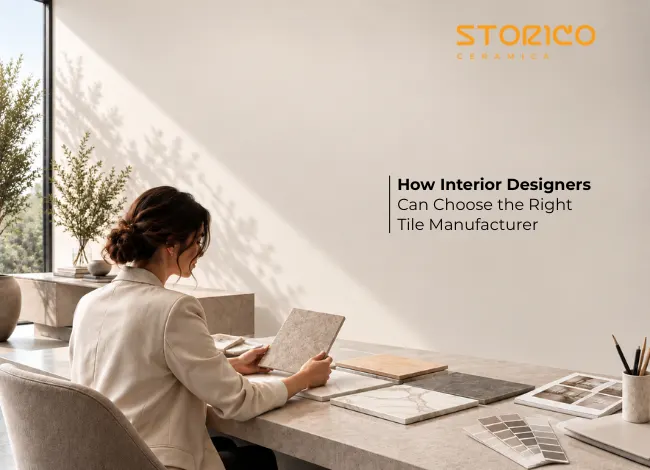
How Interior Designers Can Choose the Right Tile Manufacturer
For an interior designer, tiles are more than a finishing material.
They influence the mood, visual balance and overall character of a space. But choosing the right tile is not only about finding an attractive design. Designers also need to consider consistency, availability, technical suitability, project requirements and the reliability of the manufacturer behind the collection.
The right manufacturing partner can make the design process easier — from selecting collections to executing the final project.
1. Start With the Design Concept
Before choosing a manufacturer, define what the project actually needs.
Consider:
- Overall design style
- Colour and material palette
- Intended application
- Required sizes
- Surface finishes
- Indoor or outdoor use
- Project budget
- Quantity requirements
A residential project may need completely different collections from a hospitality, retail or commercial project.
Instead of starting with a catalogue, start with the design concept. Then look for a manufacturer whose collections can support that vision.
2. Look for Design Variety
Interior designers often work across very different styles and projects.
A useful manufacturing partner should offer enough design variety to help designers explore different directions without constantly changing suppliers.
Look for manufacturers offering:
- Contemporary and classic designs
- Stone and marble-inspired aesthetics
- Different colours and textures
- Multiple formats
- Various surface finishes
- Collections suitable for different interior styles
The goal isn't simply to have hundreds of designs.
It is to have relevant design choices that can translate into real projects.
3. Check Consistency, Not Just Appearance
A tile can look perfect in a sample and still create problems during a large project if consistency is not maintained.
Interior designers should consider:
- Shade consistency
- Dimensional accuracy
- Surface quality
- Batch consistency
- Packaging
- Quality control
- Production reliability
Consistency becomes particularly important when tiles are being used across large areas or multiple spaces within the same project.
A reliable manufacturer should have quality-control processes designed to maintain consistency from production to shipment.
4. Consider How the Manufacturer Supports Designers
A good manufacturer should make the designer's job easier.
Beyond providing tiles, manufacturers can support designers with:
- Samples
- Product specifications
- High-quality images
- Technical information
- Collection details
- Application references
- Design recommendations
- Customisation discussions where required
This information helps designers evaluate materials faster and present suitable options to clients.
When a manufacturer understands the design process, the relationship becomes more collaborative rather than simply transactional.
5. Think About Project Execution
The right collection is only useful if it can be supplied when the project needs it.
Before specifying a tile, designers should understand:
- Can the manufacturer maintain supply?
- Can the required quantity be produced?
- Is the collection likely to remain available?
- Can the manufacturer support repeat requirements?
These questions become even more important for large residential developments, hospitality projects, retail spaces and commercial interiors.
Design decisions should consider not only how a material looks today, but also how reliably it can be delivered throughout the project.
6. Choose a Manufacturer Who Understands Collaboration
Interior design is collaborative by nature.
Designers work with clients, contractors, suppliers, developers and manufacturers. A responsive manufacturing partner can help solve material-related challenges before they become execution problems.
The best relationships go beyond:
“Here is our catalogue.”
They move toward:
“Tell us what your project needs.”
That can include discussing new design requirements, project-specific selections, technical questions, samples or potential customisation.
A manufacturer who listens to designers can become a valuable part of the creative process.
7. Evaluate the Manufacturer for the Long Term
A single successful project is useful.
A reliable long-term manufacturing relationship is even more valuable.
Before choosing a supplier, look at the bigger picture:
- Manufacturing capabilities
- Quality standards
- Design development
- Production capacity
- Export experience
- Communication
- Product availability
- Ability to support future projects
The ideal partner should be capable of growing with your design practice and supporting projects across different markets and applications.
What Should Interior Designers Look for in a Tile Manufacturer?
A strong tile manufacturing partner combines design, consistency, reliability and collaboration.
The right manufacturer should provide more than attractive collections. They should give designers confidence that the material selected during the design stage can be supported through procurement and execution.
For interior designers, the ideal relationship is therefore not simply:
Designer → Supplier
It is:
Designer → Manufacturing Partner
At Storico Ceramica, we believe manufacturers can play a bigger role in helping designers turn concepts into finished spaces — through design development, manufacturing expertise, quality consistency and responsive collaboration.
Choose a Partner That Supports Your Design Vision
The right tile manufacturer should complement your creative process, not complicate it.
Start with your design concept.
Evaluate the manufacturer's capabilities.
Check consistency and reliability.
Look beyond the catalogue.
And choose a partner who can support your project from idea to execution.
Because great interiors need more than beautiful materials.
They need the right manufacturing partner behind them.
Frequently Asked Questions
Design variety, quality consistency, available formats and finishes, technical information, samples, production capability and reliable supply are important considerations.
Consistent shade, dimensions and surface quality help maintain a uniform appearance across large areas and different spaces.
For larger or specialised projects, working directly with a manufacturer can provide better access to product information, samples, technical support and project-specific discussions.
Manufacturers can provide samples, specifications, imagery, collection information, technical guidance and support for project-specific requirements.
Consistent quality, reliable production, design development, responsive communication and the ability to support future project requirements.

Porcelain Tile Manufacturer & Exporter
As a trusted porcelain tiles manufacturer from India, Storico Ceramica shares practical insights backed by real manufacturing and global export experience. Our content focuses on helping buyers understand porcelain floor tiles and large format porcelain tile solutions with clarity.
Recent Blogs