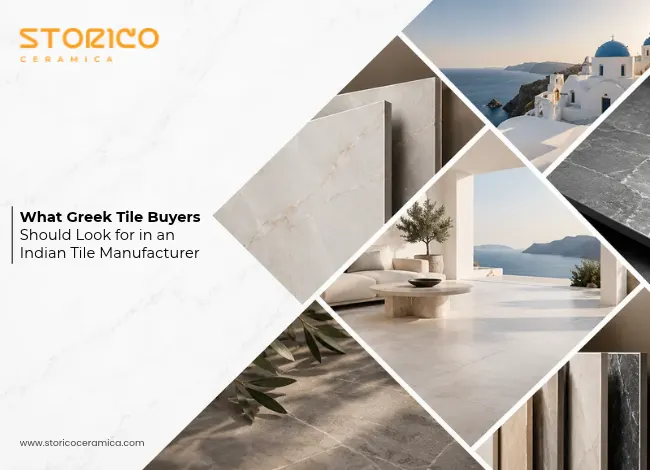
What Greek Tile Buyers Should Look for in an Indian Tile Manufacturer
Greece has a well-established market for ceramic and porcelain tiles, serving residential construction, hospitality developments, commercial projects and renovation requirements.
For Greek tile importers and distributors, finding the right international manufacturing partner is about more than comparing catalogues and prices.
The real challenge is identifying a manufacturer who understands the Greek market, maintains consistent quality and can support long-term business growth.
India, particularly Morbi in Gujarat, is an important ceramic manufacturing hub offering a wide range of porcelain tile designs, formats and finishes.
But how should Greek buyers evaluate an Indian tile manufacturer before beginning a sourcing relationship?
Here are seven important factors to consider.
1. Does the Manufacturer Understand the Greek Market?
Every market has different design preferences, commercial requirements and customer expectations.
Greek distributors may serve residential retailers, architects, hospitality developers and construction companies, each with different purchasing priorities.
Before choosing a manufacturer, discuss:
- Which collections suit your target customers?
- Are suitable formats and finishes available?
- Can the manufacturer accommodate your portfolio requirements?
- Does the supplier understand European technical and documentation expectations?
A good manufacturing partner should understand what you want to sell, not simply what they want to manufacture.
2. Can They Offer the Right Product Range?
A strong product portfolio helps Greek distributors serve multiple customer segments without relying on too many suppliers.
When evaluating an Indian tile manufacturer, consider whether its collections cover different design directions, applications and price segments.
For example, buyers may explore marble-inspired surfaces for sophisticated interiors, natural-stone aesthetics for contemporary spaces and large-format tiles for architectural projects.
Also evaluate whether the manufacturer offers coordinated designs across relevant sizes and finishes.
The objective is not to find the largest catalogue.
It is to find collections that make commercial sense for your customers.
3. How Consistent Is Their Manufacturing Quality?
A sample may look excellent, but Greek importers need confidence that commercial shipments will match approved expectations.
Quality evaluation should include:
- Dimensional accuracy
- Shade and surface consistency
- Water absorption and relevant technical properties
- Manufacturing quality-control procedures
- Packaging and shipment inspection
For products placed on the EU market, buyers should also verify applicable harmonised standards, CE marking requirements, Declaration of Performance documentation and relevant test information.
Ask the manufacturer to provide product-specific documentation rather than relying on general quality claims.
4. Can the Manufacturer Support Reliable International Supply?
International sourcing involves production schedules, shipping arrangements and documentation.
For Greek importers, reliable supply planning is particularly important when products are intended for retail distribution or scheduled construction projects.
Discuss:
Production lead time: How long does manufacturing normally take?
Order planning: Can the supplier accommodate repeat requirements?
Packaging: How are products protected during container transportation?
Shipping: Which ports and delivery terms are available?
Documentation: Can the manufacturer provide the necessary export paperwork?
Greek buyers should also clarify responsibilities under the agreed Incoterms and confirm import requirements with their customs or logistics partner.
A manufacturer who communicates realistic timelines is often more valuable than one who simply promises fast delivery.
5. Does the Manufacturer Offer Competitive Long-Term Value?
Price is an important consideration, but the lowest quotation does not always produce the best business outcome.
Greek distributors should evaluate the complete landed cost, including:
- Product price
- Freight and insurance
- Import duties and taxes, where applicable
- Customs clearance
- Warehousing
- Breakage and replacement risk
Compare quotations using equivalent specifications, quantities and delivery terms.
A reliable manufacturer with consistent quality and predictable supply may help reduce costs that are not immediately visible in the initial quotation.
The goal should be profitable sourcing, not simply low-cost purchasing.
6. Can They Support Your Business as It Grows?
Your first order may involve a limited collection.
But what happens when customer demand increases?
A manufacturing partner should be evaluated for its ability to support future requirements.
Consider its approach to new collection development, production planning, repeat orders, market feedback and communication.
For Greek distributors, this can be especially valuable when expanding into new retail locations, customer segments or project business.
The right manufacturer should be willing to discuss where your business is going, not only what you need today.
7. Are They Interested in Building a Long-Term Partnership?
A successful international sourcing relationship depends on trust, communication and shared expectations.
Before finalising a supplier, evaluate how the company responds to questions, handles technical discussions and communicates commercial commitments.
Does the team understand your requirements?
Are quotations and specifications clear?
Do they provide realistic timelines?
Are they responsive when questions arise?
A strong relationship develops when both parties understand their responsibilities and work toward sustainable business growth.
A Quick Checklist for Greek Tile Buyers
| Evaluation Area | What to Check |
| Market Fit | Collections relevant to Greek customers |
| Product Range | Designs, sizes, finishes and applications |
| Quality | Samples, consistency and testing |
| EU Requirements | Applicable CE and technical documentation |
| Manufacturing | Capacity and repeat-order capability |
| Logistics | Packaging, lead times and shipping terms |
| Commercials | Landed cost, MOQ and payment terms |
| Partnership | Communication and long-term support |
Use this checklist to compare shortlisted manufacturers before placing your first commercial order.
Exploring an Indian Tile Manufacturing Partner? Meet Storico Ceramica
For Greek businesses exploring international sourcing opportunities, working with a manufacturer in India can provide access to additional collections and manufacturing options.
Based in Morbi, Gujarat, Storico Ceramica is an Indian porcelain tile manufacturer and exporter offering collections for international markets.
Our product range includes marble, stone, wood and contemporary surface aesthetics, with multiple formats and finishes for different design and project requirements.
For Greek tile importers, distributors and project buyers, we welcome discussions around collection selection, specifications, export requirements and potential long-term sourcing relationships.
Looking for an Indian tile manufacturer for your Greek market?
Explore Storico Ceramica's collections and connect with our team to discuss your business requirements.
Frequently Asked Questions
Greek importers can identify manufacturers through industry exhibitions, referrals, online research and direct factory enquiries. Before ordering, verify manufacturing capabilities, product quality, export documentation, commercial terms and references.
Buyers should review product specifications, applicable EU compliance requirements, samples, quality consistency, shipping arrangements, landed costs and supplier reliability.
Indian manufacturers may offer collections suitable for hospitality projects. Buyers should verify application-specific technical performance, available quantities, documentation and project delivery requirements before selection.
No. Greek importers should consider landed cost, quality consistency, logistics, product suitability and long-term supply reliability alongside the quoted price.
Storico Ceramica is based in India's Morbi ceramic manufacturing hub and offers porcelain tile collections for international buyers. Greek businesses can contact the company to discuss product availability, technical specifications and sourcing requirements.

Porcelain Tile Manufacturer & Exporter
As a trusted porcelain tiles manufacturer from India, Storico Ceramica shares practical insights backed by real manufacturing and global export experience. Our content focuses on helping buyers understand porcelain floor tiles and large format porcelain tile solutions with clarity.
Recent Blogs